Daugavgrīva
Biogas from treatment sludge covers almost all heat and much of the electricity needs via cogeneration.
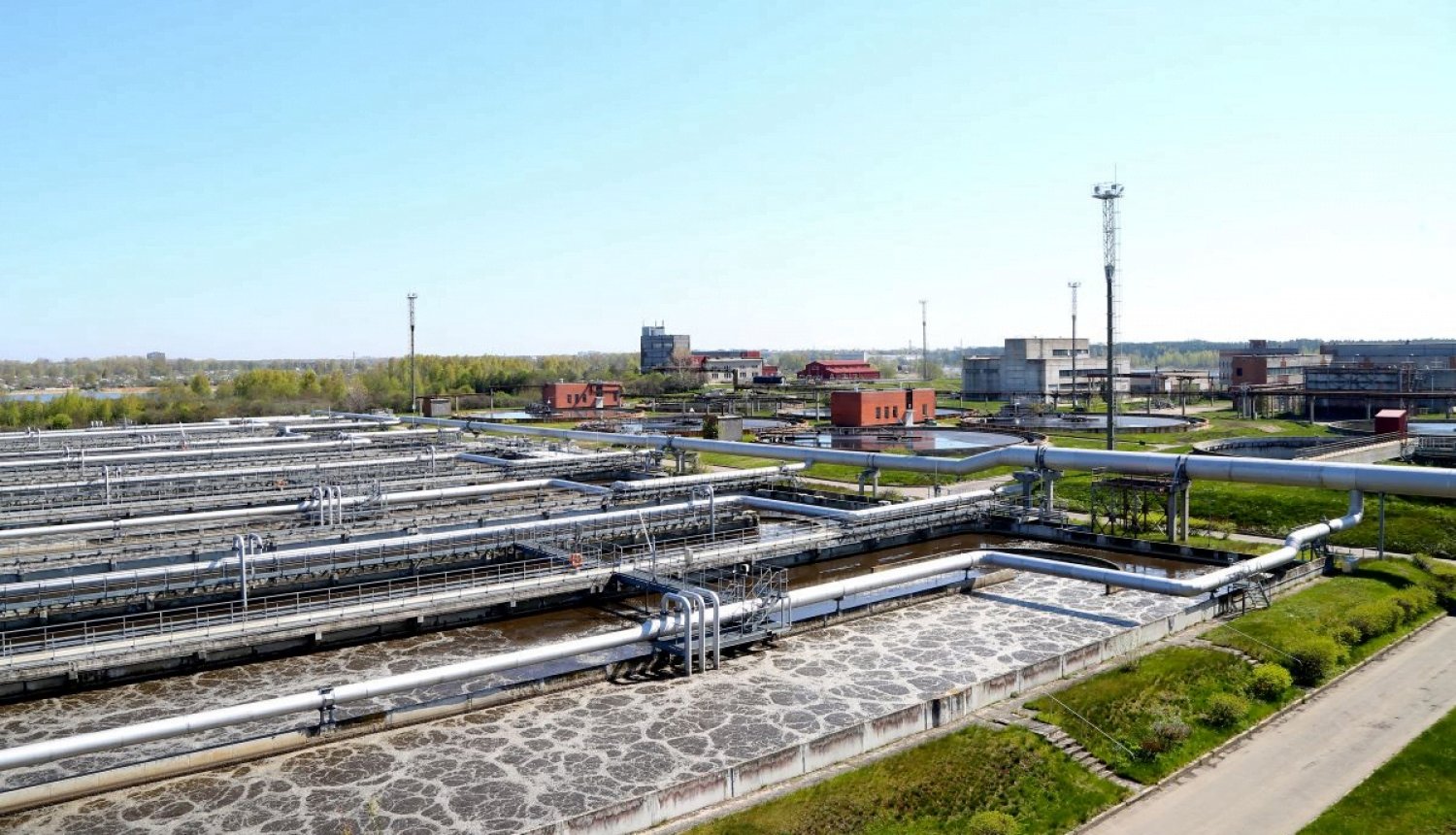
The biological treatment plant “Daugavgrīva” is a large cluster of wastewater treatment and processing technology where the principle of industrial symbiosis has been applied for many years.
Three treatment stages
Before the water flows into the Gulf of Riga it has to pass three treatment stages.
Mechanical treatment. The city's wastewater first arrives through two sewer pipes into the intake chamber of the treatment plant, then passes mechanical screens that remove large pollutants such as plastic packaging and rubber items. The method relies on gravimetric and filtration separation and removes insoluble solids.
Physico-chemical treatment. After mechanical treatment the wastewater, mixed with the coagulant Fe2(SO4)3, enters the primary settling tanks. During settling, which takes about 4 hours, small dispersed particles bind into larger compounds that sink to the bottom of the tanks under gravity. The primary sludge is then pumped to the sludge treatment area.
Biological treatment. After the mechanical and physico-chemical stages the water enters the aeration basins, where biological treatment takes 8 to 12 hours using activated sludge and aeration. The biologically treated water is discharged into the Gulf of Riga about 2.4 km from the shoreline at a depth of 15 m.
Symbiosis at the treatment plant
The plant's main task is not only to treat the wastewater arriving from Riga and the Riga region efficiently, but also to make rational use of the residues left after treatment: sludge, sand, organic matter and others.
The “Daugavgrīva” treatment facilities process an average of 130 000 to 140 000 cubic metres of wastewater a day, and on rainy days the volume can reach 170 000 to 180 000 cubic metres.
Treatment produces several residues. Sand mixed with organic matter comes out of the first cleaning stage, and the company is developing a method to separate the useful organic matter from the sand so it can be used further, for example in bioreactors. Treated sludge forms during wastewater treatment, and part of the spent sludge from the primary settling tanks travels through a pumping station to the bioreactors, where biogas is produced. The water formed when sludge is dewatered is treated with coagulants and phosphates and returned to the inlet for a new treatment cycle.
Biogas, heat and electricity
The plant produces around 100 tonnes of sludge a day, which it plans to use as compost, that is, as fertiliser.
Wet fermentation in the bioreactors produces biogas continuously, and the plant uses it as the main fuel of its own combined heat and power station. That station has two gas generators with a capacity of 2.5 MW. The heat and electricity they generate is used in the production cycle for lighting and equipment, and for heating the buildings.
Heat and electricity are produced in a ratio of roughly 55 % to 45 %. The gas installations cover almost all of the plant's heat demand, from 85 to 100 %, and more than half, about 60 %, of its electricity demand.
Modernisation and cooperation
The plant is modernised regularly so that treatment fully meets present-day requirements. In 2014, for example, the reconstruction of its biological treatment basins and automated control system was completed, which reduced the amount of nitrogen and phosphorus discharged.
Alongside modernisation, Daugavgrīva has enjoyed the benefits of industrial symbiosis for many years through cooperation with Getliņi EKO and Latvenergo. Production waste that cannot yet be processed at the plant is taken to the Getliņi EKO landfill for sorting and disposal: over a year more than 280 tonnes of waste from the mechanical filters and more than 2544 tonnes from the sand traps are sent there. When the plant produces surplus electricity, it sells it to Latvenergo, the largest energy company in Latvia.