Latvia's production by-product classifier
Do you think you have waste that could be classified as by-products?
Structured information on by-products from Latvian production and food processing, their potential uses, and industrial-symbiosis solutions.
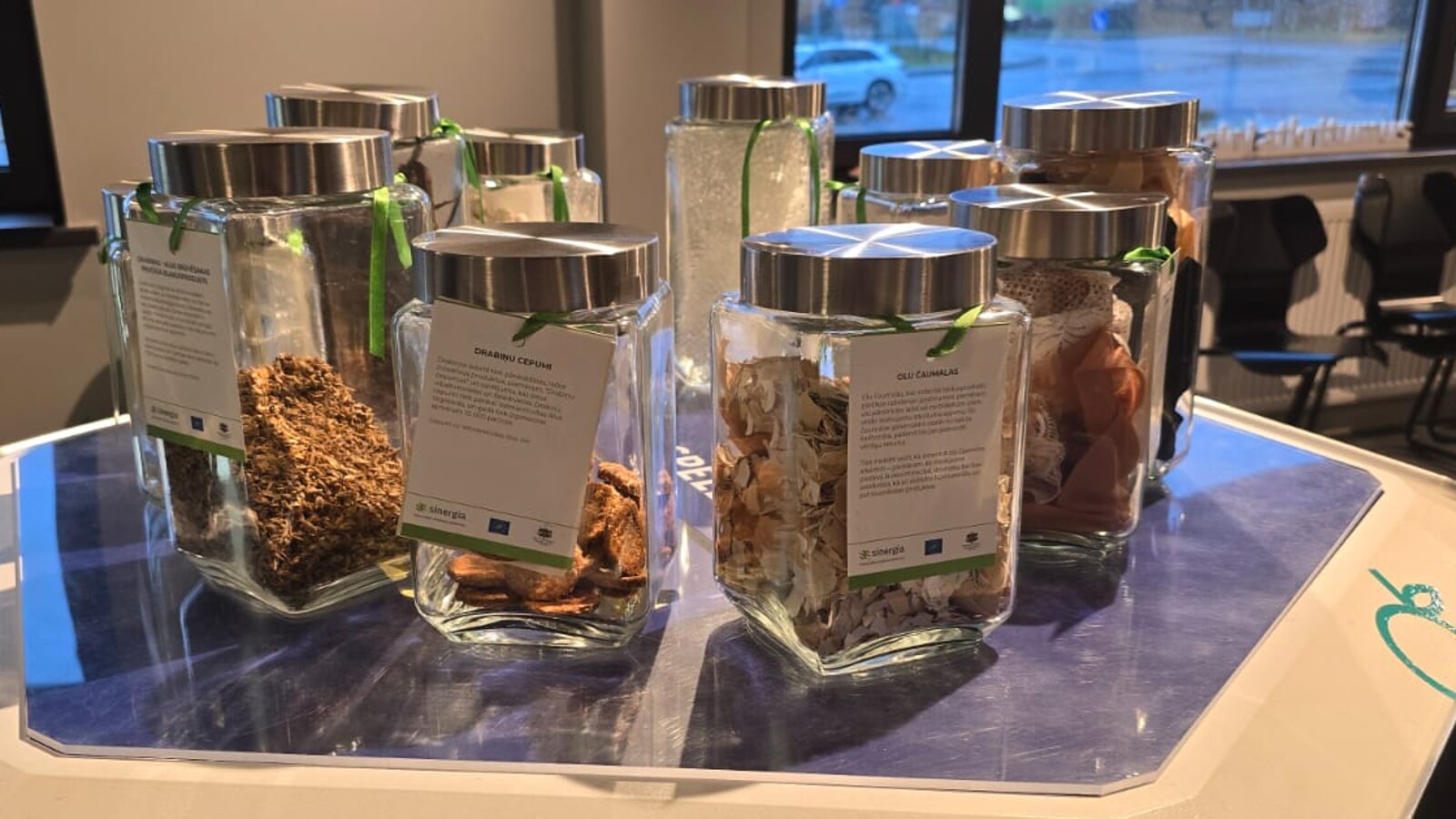
What are your sector's challenges and solutions in using production by-products?
The SINERGIA team helps companies, industry associations and public-sector organisations identify by-products, analyse resource flows and develop industry-specific classifiers for industrial symbiosis and the circular economy, and to identify new business-development projects and potential new jobs.
We invite you to share your own ideas or experience about which waste you would like classified as by-products. We can also help you develop a by-product study for your sector.
About the classifier
The Latvian industrial by-product classifier was developed within the project “Development of preconditions for industrial symbiosis implementation and strengthening VVD competence” (LVAF project No. 1-08/95/2024), delivered by the Cleantech Latvia association together with the State Environmental Service.
It is a practical tool for companies, public institutions and research organisations that want to use resources more efficiently.
For now the classifier covers the by-products identified during the project and the ways they could be used. In future we want to extend it with further sectors, company data and industrial-symbiosis examples, building a single information system for resource circulation in Latvia.
Developing it further would improve access to data, help manage resource flows and support sustainable economic development.
What is a by-product?
By-products are production residues that meet the conditions of Article 5(1) of EU Directive 2008/98/EC. Those conditions, transposed through point 5 of Cabinet Regulation No. 302, state that a by-product is a substance or object arising in a production process at an installation where producing it is not the main aim of that process.
Where the criteria in the Regulation are met, the operator classifies the substance or object not as waste but as a by-product, and only if it meets all of the following criteria at the same time:
Purpose
Approach
The classifier draws on EU regulation, international practice and Latvian industry specifics, including Catalonia's (Spain) by-product accounting system.
Classification is based on sector, origin, physico-chemical properties, potential use, European waste classification codes and possible symbiosis solutions.
The report
The report “Classifying production residues in the circular economy and industrial symbiosis” covers EU and Latvian good practice, an assessment of two sectors (dairy and brewing) and practical company guidelines: 8 steps for classifying production residues. We share it as an example of our work with potential partners.
We support open access to data in support of the circular economy. If you republish, analyse or use this information in studies and reports, please cite the report on this website.
| Sector | By-product | Waste code | New by-product code | Potential use | Description | Classification status |
|---|---|---|---|---|---|---|
| Dairy processing | Sweet whey | 020599 | B-020599-DB-SS | Animal feed, food ingredients | Sweet whey can be added to animal feed or used as a source of protein and lactose in food production. | Evaluated |
| Dairy processing | Sweet whey | 020599 | B-020599-BE-SS | Bioethanol production (fermentation) | Fermenting lactose with yeast yields bioethanol, a renewable energy source. | Evaluated |
| Dairy processing | Sweet whey | 020599 | B-020599-LA-SS | Lactic acid / biotechnology products | Whey serves as a fermentation substrate, yielding lactic acid and other bio-products for the food and chemical industries. | Evaluated |
| Dairy processing | Sweet whey | 020599 | B-020599-BP-SS | Bioplastic (PHA) | Lactose is used as a raw material for polyester (PHA) bioplastics, reducing the use of fossil resources. | Evaluated |
| Dairy processing | Acid whey | 020599 | B-020599-BG-SC | Biogas production | Anaerobic digestion to produce biogas. | Evaluated |
| Dairy processing | Acid whey | 020599 | B-020599-AU-SC | Fertiliser / soil improver | Mineral-rich whey improves the soil and promotes plant growth. | Evaluated |
| Dairy processing | Acid whey | 020599 | B-020599-LA-SC | Lactic acid fermentation | Used as a substrate for producing lactic acid for the food and chemical industries. | Evaluated |
| Dairy processing | Cheese whey | 020599 | B-020599-DB-SI | Animal feed, food ingredients | Cheese whey is added to feed or food as a source of protein and carbohydrates. | Evaluated |
| Dairy processing | Cheese whey | 020599 | B-020599-BE-SI | Bioethanol production (fermentation) | Fermenting lactose yields bioethanol for energy use. | Evaluated |
| Dairy processing | Cheese whey | 020599 | B-020599-BP-SI | Bioplastic (PHA) | Cheese whey as a raw material for PHA biopolymers. | Evaluated |
| Dairy processing | Flotation sludge | 020599 | B-020599-BD-FL | Biodiesel production | The fats in flotation sludge are processed into biodiesel. | Evaluated |
| Dairy processing | Flotation sludge | 020599 | B-020599-BG-FL | Biogas production | The organic-matter content is suited to anaerobic digestion. | Evaluated |
| Dairy processing | Flotation sludge | 020599 | B-020599-ZK-FL | Soap and chemical products | Once purified, the fat fractions are used to make soap and detergents. | Evaluated |
| Dairy processing | Sediment and surplus sludge | 020502 | B-020101-AU-ND | Compost, fertiliser | Composted and used as an organic soil fertiliser. | Evaluated |
| Dairy processing | Sediment and surplus sludge | 020502 | B-020101-BG-ND | Biogas production | Anaerobic digestion to produce biogas. | Evaluated |
| Dairy processing | Milk unfit for processing | 020501 | B-020501-BG-PN | Biogas production | A high lactose and protein content makes it a valuable substrate for biogas. | Evaluated |
| Dairy processing | Ash | 100101 | N/A | Fertiliser / soil improver | N/A | Potential |
| Dairy processing | Ash | 100101 | N/A | Construction, road infrastructure | N/A | Potential |
| Dairy processing | Milk unfit for processing | 020501 | B-020501-DB-PN | Animal feed (after pasteurisation) | After suitable heat treatment or pasteurisation and a reduction in water content, it can be used as a protein and calcium enricher in specific animal-feed formulas, or as a component of fermented feed products. | Evaluated |
| Dairy processing | Milk unfit for processing | 020501 | B-020501-BE-PN | Bioethanol production (fermentation) | Lactose is fermented into bioethanol (using the enzyme lactase and others). | Evaluated |
| Brewing | Spent grain | 020704 | B-020704-KE-DR | Ceramics, brick production | Mixing spent-grain fractions with clay produces bricks with greater porosity and better thermal insulation. | Evaluated |
| Brewing | Spent grain | 020704 | B-020704-DB-DR | Animal feed; food raw material | Spent grain (residue from the juice and malt) can supplement animal feed, for example for pigs and cattle, adding protein and fibre. | Evaluated |
| Brewing | Spent grain | 020704 | B-020704-BG-DR | Biogas production | Spent grain suits anaerobic digestion for biogas well, though the dry/wet fraction should be adjusted and mixed with other types of substrate. | Evaluated |
| Brewing | Spent grain | 020704 | B-020704-BE-DR | Bioethanol production | After saccharification or hydrolysis, spent grain can be a source of sugars or fermentable substrate for ethanol, though pre-treatment is needed to increase the available sugar. | Evaluated |
| Brewing | Spent grain | 020704 | B-020704-SA-DR | Mushroom-growing substrate | Spent grain can be used on its own or combined with sawdust or wheat bran to make a nutritious substrate for growing Pleurotus ostreatus (oyster mushroom) and other edible mushrooms. | Evaluated |
| Brewing | Spent yeast | 020799 | B-020799-DB-RA | Animal feed / protein source | Yeast can serve as a protein source in animal feed, or as a food additive enriching products with vitamins and folates. | Evaluated |
| Brewing | Spent yeast | 020799 | B-020799-BG-RA | Biogas production | Yeast can be used as a substrate for anaerobic digestion in biogas production, replacing part of the fossil resources. | Evaluated |
| Brewing | Spent yeast | 020799 | B-020799-AU-RA | Fertiliser / soil improvement | Yeast can be composted and used as an organic fertiliser that improves soil fertility. | Evaluated |
| Brewing | Spent yeast | 020799 | B-020799-BE-RA | Bioethanol production | Yeast can be a nutrient source for the bacteria used in ethanol production. Adding yeast to corn steep liquor improves the rate of ethanol production and shortens the time needed to use up the sugar. | Evaluated |
| Brewing | Spent yeast | 020799 | B-020799-PR-RA | Recovery of β-glucans / mannoproteins | β-glucans and mannoproteins can be recovered from yeast cell walls for the pharmaceutical and food industries. | Evaluated |
| Brewing | Spent kieselguhr | 020799 | B-030307-BM-KI | Cement industry, building materials | After dewatering and calcination, kieselguhr can be used as a filler or a partial clinker substitute in cement and concrete. It cuts the CO2 emissions of cement and improves the porosity of the material. | Evaluated |
| Brewing | Spent kieselguhr | 020799 | B-030307-BP-KI | Bioplastic production | Fibres and proteins recovered from kieselguhr can be used in biopolymer production as fillers or structural additives in bioplastics. | Evaluated |
| Brewing | Spent kieselguhr | 020799 | B-030307-AU-KI | Soil improvement | Dried and composted kieselguhr is added to soil as an organic fertiliser. It improves soil structure and raises the organic carbon content. | Evaluated |
| Brewing | Sediment from cleaning and fermentation | 020301 | B-020301-BG-NT | Biogas production | Organic sediment is processed into biogas for energy. | Evaluated |
| Brewing | Sediment from cleaning and fermentation | 020301 | B-020301-AU-NT | Compost production | The sediment is composted together with other biomass to make an organic fertiliser. This returns nutrients to the loop and improves soil fertility. | Evaluated |
| Brewing | Sediment from cleaning and fermentation | 020301 | B-020301-EN-NT | Renewable energy production | Dried sediment can be used as an alternative fuel, replacing fossil resources in heat and power production. | Evaluated |
| Glass fibre | Wastewater sludge (Zn, Al) | N/A | N/A | Recovery of metal compounds (ZnO, Al₂O₃) | Example: Valmiera Glass fibre (acceleration) | Company practice |
| Wood processing | Sawdust and wood chips | N/A | N/A | Heat energy, board production | Example: Stora Enso | Company practice |
The classifier currently covers the by-products identified within the SINERGIA project and their potential uses.
In future it can be extended with new industries, company data and industrial-symbiosis examples, building a unified Latvian resource-circulation information system.
Developing the classifier would improve data availability, resource-flow management and support sustainable economic development.